How to Evaluate a Bottle Decoration Supplier Before You Commit
A decorator is easier to assess than a fragrance house, because decoration is visible and testable. You can hold the output, rub it, soak it and measure it, which means the evaluation should be based on evidence rather than on presentation. The four things worth checking are the written process window, who actually performs the work, how colour is controlled, and what happens when units fail. A supplier that answers all four with specifics is a low-risk partner even if the first sample is imperfect; one that answers with confidence and no numbers is a risk regardless of how good the sample looks.
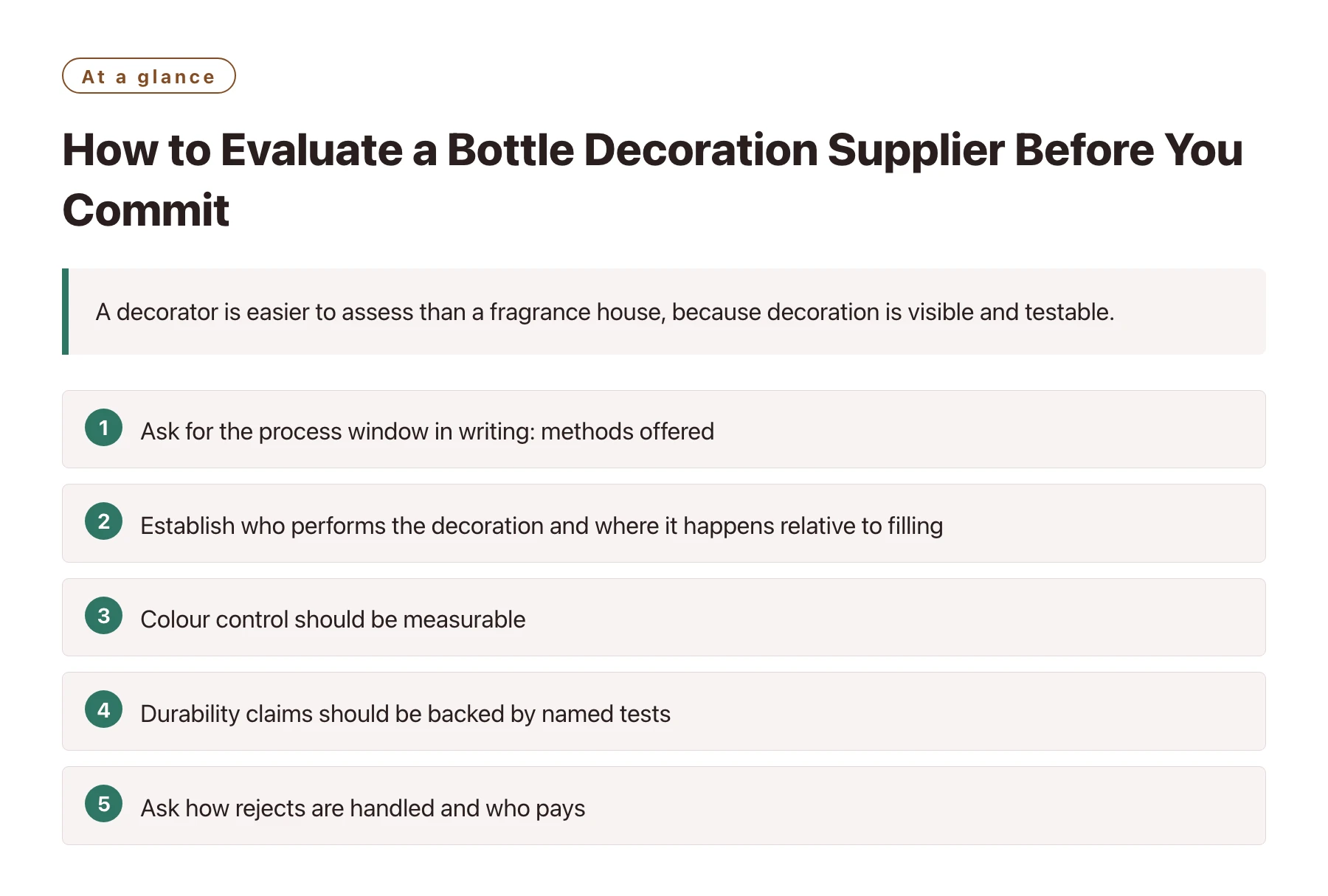
Key takeawaysAsk for the process window in writing: methods offered, minimum line weight and type size, position tolerance and the surfaces the process cannot handle. · Establish who performs the decoration and where it happens relative to filling, since subcontracting adds handoffs and points of failure. · Colour control should be measurable, with a stated reference, a stated light source and a stated tolerance for variation. · Durability claims should be backed by named tests, not adjectives; abrasion, tape adhesion and product exposure are the three that matter most. · Ask how rejects are handled and who pays, because the answer reveals more about a supplier than the quoted unit price does.
Most buyers evaluate a decorator by sending an artwork and judging the sample that comes back. That is a reasonable first filter and a poor basis for choosing a partner, because a careful hand sample says almost nothing about how the process behaves on a running line.
A better approach is to evaluate the process and then use the sample as confirmation. The questions below are ordered that way: capability first, evidence second, commercial terms third.
Nothing here requires technical expertise in printing. It requires knowing which answers are specific enough to be useful.
Start with the written process window
Every decoration method has limits, and a competent decorator knows them precisely because they are encountered daily. When those limits are not written down, the buyer discovers them one failed artwork at a time.
Ask for a short capability statement rather than a brochure. It should be specific enough that a designer could use it as a design constraint.
What the statement should contain
The methods offered, the substrates each is used on, the minimum line weight and minimum type size, the position tolerance in millimetres, the maximum and minimum component dimensions, and any surface the process cannot handle reliably. A decorator who cannot state the tolerance is not measuring it.
Who actually does the work
Ask which steps are performed in house and which are bought in. Subcontracting is common and not automatically a weakness, but it changes lead time and it splits responsibility when something goes wrong. It also matters whether decoration happens before or after filling, because that sequence determines how many times the decorated surface is handled. A supplier that controls design, filling and packing can describe one sequence; where that whole scope is published on a single page, as on the official Xuelei website, the sequence tends to be documented rather than improvised, and it is easier to question precisely. Xuelei sets out the same logic for the wider supplier relationship.
A short evaluation sequence that produces evidence
- Request the capability statementOne page, numeric, specific to the component you are decorating rather than to decoration in general.
- Send a test artworkInclude fine type, a fine line and a solid colour block, so the sample shows both the detail limit and the colour laydown.
- Ask for the actual glassDecoration applied to the bottle you will use, not to a generic sample of similar size.
- Run three checks yourselfAbrasion with a defined rub, adhesion with tape, and exposure to the fragrance plus an alcohol-based product.
- Let one sample sitKeep a decorated bottle for several weeks in daylight and see whether the finish changes before you commit to volume.
- Ask for a batch recordOne record from a previous run, showing material lots, process settings and inspection results.
- Compare like with likePut both suppliers' answers side by side on the same form, then discuss the price.
Colour control is where suppliers separate
Colour is the most common source of disputes in decoration, and almost every dispute traces back to an approval that was never pinned down. A supplier with real control will have a reference standard, a measurement method and an agreed tolerance for how far a production unit may sit from that standard.
The practical questions are short. Is the reference a physical master, a measured value, or both? Under which light source is approval given, and under which light source is the line inspected? What happens when a batch drifts to the edge of tolerance?
If the answers are vague, the risk is not that the colour will be wrong on day one. It is that nobody will be able to agree on whether it is wrong later, which is worse.
Ask for the test list, not the test result
Most suppliers will share a passing result. Ask instead which tests they run routinely on decorated components and how the result is recorded. Adhesion after abrasion, adhesion after immersion, resistance to alcohol and resistance to the product itself cover the failures that actually reach consumers. Third-party laboratories publish the frameworks for this kind of testing, and a supplier working with one will recognise the vocabulary immediately [1].
Ask who owns the tooling
Screens, dies and fixtures are made for one artwork. Ask where they are stored, whether they are insured, and what happens to them if the programme pauses. It is also worth checking whether the artwork or the bottle surface treatment is registrable as an industrial design in your markets, and if so, who holds it [2]. Ownership conversations are easy before the first order and much harder afterwards.
Red flags worth taking seriously
A supplier who cannot state a position tolerance is guessing. A supplier who will not say which steps are subcontracted is avoiding the question. A supplier who quotes a price without asking what the artwork contains has not costed it.
None of these are fatal on their own. What matters is whether the answers become specific once you ask directly. A useful test is to send the same technical question to two candidates and compare the depth of the reply, which is a fairer comparison than comparing quotations built on different assumptions. This is the same discipline covered in Xuelei's guide, and it applies to decorating vendors without much modification.
Keep the evaluation material. The capability statement, the approved sample, the measured colour value, the test results and the tooling ownership note form the technical file for the programme. If a dispute arises in a year, that file is what settles it, and assembling it afterwards is close to impossible.
Sources
- SGS: Cosmetics, Personal Care & Household Testing —— Testing, inspection and certification services for cosmetics and personal care, including microbiological, stability and safety testing aligned with cosmetics GMP.
- WIPO — World Intellectual Property Organization —— The UN agency for intellectual property; resources on industrial design and patent protection relevant to product and packaging design.
Frequently asked questions
Should I choose the cheapest decorator?
Not on price alone. A lower unit price paired with a high reject rate or a slow response on technical questions usually costs more than a well-specified process at a slightly higher rate, because the hidden cost is rework and delay.
How long should I test a decorated sample before committing?
Long enough to see a change if one is going to appear. Several weeks in daylight, plus contact with the product and an alcohol-based product, will surface most adhesion and colour issues before they reach consumers.
What is the most useful single question to ask a decorator?
Ask for the position tolerance in millimetres and the assumed reject rate. Those two numbers indicate whether the supplier is working from measured process data or from an impression of how the job usually goes.
Do I need to visit the factory?
A visit helps, but it is not the main evidence. A batch record, a capability statement and a sample pulled from a running line tell you more than a tour, and they can be reviewed remotely.
How many decorators should be evaluated?
Two or three, using identical artwork, the same bottle and the same question list. Beyond that the comparison gets harder to keep fair and the additional information is usually small.