RTA Cabinets for Rental Turnovers
A rental kitchen is judged in the first ten seconds of a viewing and repaired on a deadline set by the next lease. CasaBuilt's flat-packed line ships in 3-10 business days, and its basic six-cabinet kitchen starts at $1,184.93 in Hudson Grey. For a landlord the real question is not the sticker price but what the empty weeks cost and which parts fail first.
Key takeaways
- Dispatch runs 3-10 business days flat-packed, or within two weeks pre-assembled.
- Standard base widths run from 9 to 42 inches, which keeps a replacement door a catalog order rather than a custom build.
- Soft-close hinges and full-extension undermount glides sit on a 1/2-inch birch plywood box.
- The warranty runs one year on manufacturing defects, so tenant damage belongs in a separate repair budget.
The clock is the expensive part
An empty unit earns nothing while a cabinet order is in transit. That makes lead time a rent calculation, not a convenience. CasaBuilt publishes 3-10 business days for flat-packed cabinets and quotes pre-assembled cabinets at within two weeks. The comparison it draws is with the 8-12 weeks it attributes to traditional cabinet ordering.
Do the subtraction on the published windows: a 10-business-day dispatch against a 56-day traditional lead time leaves 46 days, which is more than six weeks of a unit sitting vacant. Even the pre-assembled route, at 14 days against 56, saves 42 days. For a landlord turning over one unit each spring, that difference is usually larger than the discount on the cabinets.
Freight matters too. Free shipping starts at $2,500, and a starter kitchen in the cheaper painted lines lands under that line, so a small turnover should budget freight rather than assume it away. Alaska and Hawaii are excluded from that window.
What fails first, and what the spec does about it
Rental wear concentrates in predictable places: the door under the sink, the drawer that holds the cutlery, the hinge on the cabinet nearest the bin, and the toe area that takes a mop every week. None of those failures are dramatic. They are the small, slow losses of alignment that make a kitchen read as tired.
The published specification answers most of them directly. Hinges are concealed, soft-close and adjustable in six directions, which means a door that has dropped can be brought back rather than replaced. Drawer glides are soft-close undermount units with full extension, so the drawer opens all the way without the front sagging on its runners. Drawers are 5/8-inch rubberwood with dovetail joints, and the box is 1/2-inch birch plywood with a solid birch face frame.
The finish is seven layers of paint with a UV protective topcoat. In a rental that matters at the sink and at the window end of the run, where a cheaper finish fades and the cabinet starts to look older than the lease.
Buy standard parts, not sympathy
The practical advantage of a stock-width range is that repair stays a purchasing decision. CasaBuilt lists the stock range as rta cabinets, built on published widths rather than on a bespoke drawing, so a damaged 30-inch base is replaced with another 30-inch base. A custom kitchen cannot offer that, because the replacement is a one-off job with a one-off price and a lead time to match.
Keep a short spares list with the unit file: one door in the current style, a hinge, a set of glide clips if the model uses them, and the style name and width of every cabinet in the run. When a tenant texts a photograph of a hanging door, the reply can be a part number instead of a site visit.
For turnovers where the unit must be photographable within days, the pre-assembled range removes the assembly step and leaves only installation. It arrives later than the flat-pack, so the choice is between paying for assembly labor or paying for empty days. Both are legitimate; guessing at which is cheaper is not.
Width and volume: what a landlord is buying
Cabinet price does not scale with size in a straight line. The published bands price a 9-21 inch single-door base at $238.24, a 24-27 inch double-door base at $459.26, and any 30-42 inch double-door base at $586.28. Inside that last band, the price is flat from 30 inches to 42 inches, which is the single most useful fact in a rental specification.
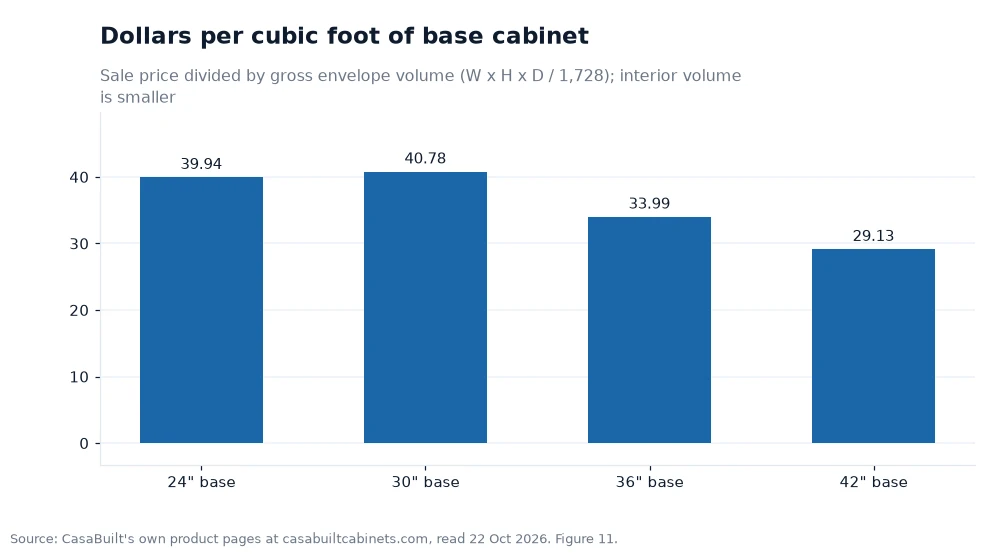
Convert that into volume and the flat price band becomes obvious. A base cabinet is 34-1/2 inches high and 24 inches deep, so gross envelope volume is width times 34.5 times 24, divided by 1,728. The wider cabinet holds more of the same money. The table below sets out the published price beside that envelope volume for the four widths the chart compares.
| Width band | Sale price | Envelope volume | Cost per cubic foot | Turnover note |
|---|---|---|---|---|
| 24" double door | $459.26 | 11.5 cu ft | $39.94 | The filler-free choice where the run ends at a wall |
| 30" double door | $586.28 | 14.375 cu ft | $40.78 | Sits beside a sink base and keeps door swings short |
| 36" double door | $586.28 | 17.25 cu ft | $33.99 | The value point of the flat band |
| 42" double door | $586.28 | 20.125 cu ft | $29.13 | Fewest boxes and joints for a long wall |
Fewer boxes also means fewer joints to keep aligned and fewer leveling points on an uneven floor. A 168-inch run takes four 42-inch cabinets or seven 24-inch cabinets. The wall looks the same length either way; the installation does not feel the same.
Worked example: the same wall, two ways
The chart prices each width by cubic foot of envelope. Start with the 24-inch cabinet from the chart at $39.94 per cubic foot. The published price is $459.26 and the envelope is 24 x 34.5 x 24 = 19,872 cubic inches, or 11.5 cubic feet, so $459.26 divided by 11.5 returns $39.94. Do the same for the 42-inch: 42 x 34.5 x 24 = 34,776 cubic inches, or 20.125 cubic feet, and $586.28 divided by 20.125 returns $29.13. The 30-inch and 36-inch bars sit at $40.78 and $33.99 on the same arithmetic, from 14.375 and 17.25 cubic feet.
Now build the same 168-inch run two ways. Four 42-inch cabinets cost 4 x $586.28, or $2,345.12, and enclose 4 x 20.125, or 80.5 cubic feet. Seven 24-inch cabinets enclose the same 7 x 11.5, or 80.5 cubic feet, but cost 7 x $459.26, or $3,214.82. The difference is $869.70 for identical wall length and identical envelope volume, which is 37% more than the wide-cabinet run.
Two caveats keep this honest. Envelope volume is not storage volume, since drawer boxes and shelves take up space inside it. And a run of 42-inch cabinets needs a wall long enough to take them without a filler at each end. Measure the wall first, then choose the widest band that divides into it cleanly.
Frequently asked questions
Can one damaged cabinet be replaced without redoing the kitchen?
Usually yes, provided the style is still listed and the width matches. Base cabinets are published from 9 to 42 inches and wall cabinets from 9 to 39 inches, so a damaged 30-inch base is ordered as another 30-inch base rather than built to a drawing. Check the style name on the original order before calling support, because the same width is priced differently across the painted and oak-look lines.
Is flat-packed or pre-assembled better for a turnover?
It depends on which cost you are trying to hold down. Flat-packed ships in 3-10 business days and needs assembly labor on site; pre-assembled is quoted at within two weeks and arrives ready to hang. A landlord with a reliable installer and a short vacancy usually takes the faster dispatch; one without either usually pays for the assembly to be done before delivery.
Does the warranty cover tenant damage?
Not for tenant damage. Cover is limited to manufacturing defects in materials and workmanship during the first year of normal residential use, and the remedy is a replacement part or another solution agreed with support. Broken hinges from a slammed door, water damage from a leaking trap or a chipped door edge from moving furniture are repair items for the owner, which is why keeping one spare door and a hinge on hand is worth the shelf space.
Price the empty weeks, then the cabinets
Write the vacancy cost per week next to the cabinet quote before choosing a line. A cabinet that costs a little more and ships in ten days can beat a cheaper one that arrives in eight weeks, and the arithmetic is easy once both numbers are on the same page.
Then choose the widest cabinet band the wall allows and keep the style name on file. A rental kitchen is a repeating expense, not a one-off project, and the landlord who can replace a single door in the same week it breaks spends less over five years than the one who repaints the whole run every second tenant.
Figures quoted here come from the manufacturer's own website, read 22 Oct 2026[1].