A Practical Guide to Coordinating factory checks before orders
A factory check before order award can reveal whether a proposed site, process, and control system fit the buyer’s product and schedule. Coordination matters: the visit needs a clear purpose, current product references, access to relevant work, a qualified review team, and an agreed route for findings. Results should inform a decision rather than create a false certification impression.
Key takeaways
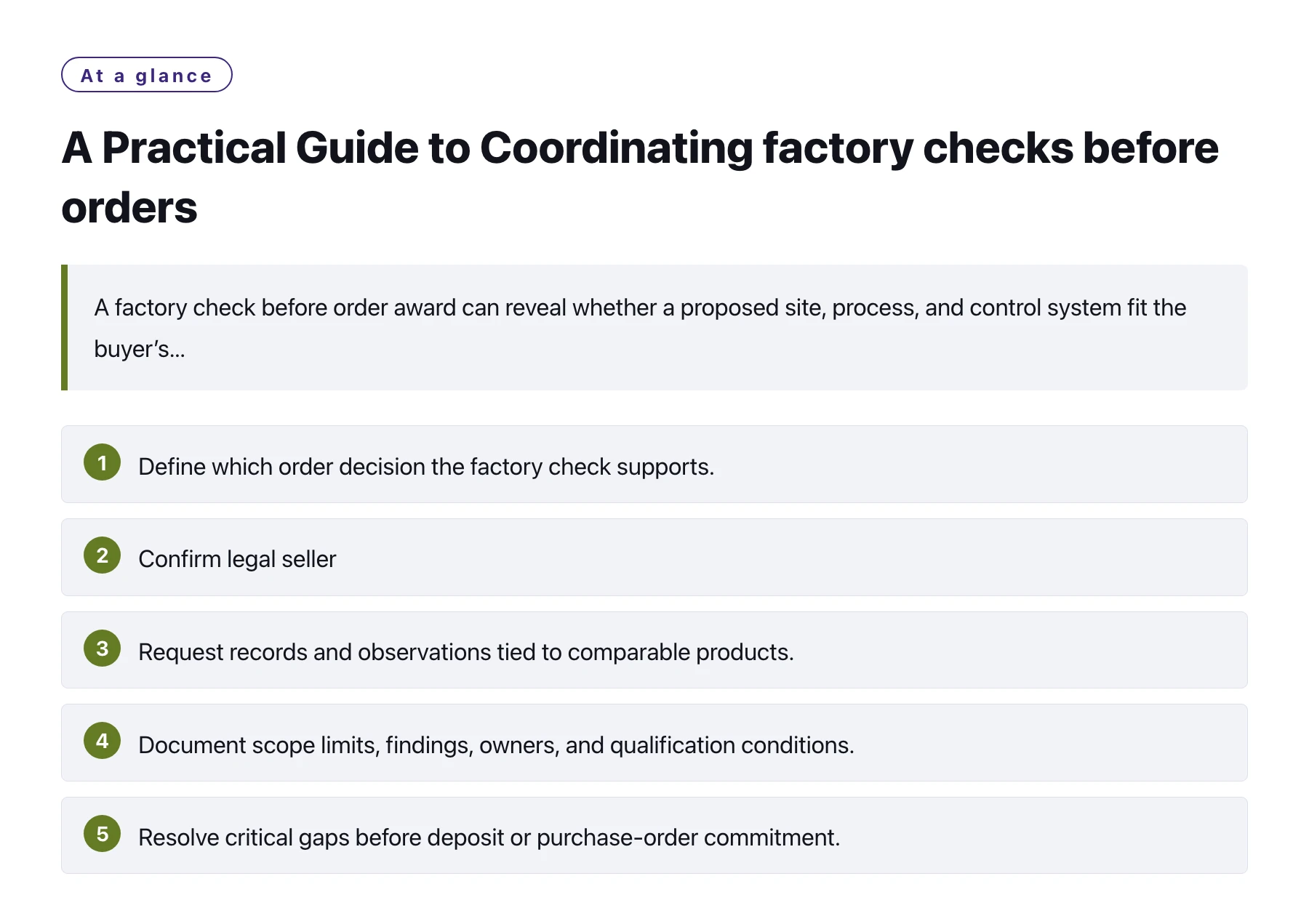
- Define which order decision the factory check supports.
- Confirm legal seller, actual production site, process map, and subcontractors.
- Request records and observations tied to comparable products.
- Document scope limits, findings, owners, and qualification conditions.
- Resolve critical gaps before deposit or purchase-order commitment.
A pre-order factory check works best as one evidence source in supplier qualification, supported by documents and product-specific review.
1. Set purpose and qualification threshold
State whether the check supports an initial shortlist, commercial award, capacity confirmation, quality review, or risk investigation. Identify product type, market, expected order size, critical processes, and what evidence must be available for the supplier to qualify.
Separate mandatory criteria from preferences and define what causes rejection, conditional approval, or follow-up. Name technical, quality, procurement, and compliance decision owners. The visit team should know which observations affect the decision and who can approve mitigation.
2. Verify the factory and contracting relationship
Confirm the proposed legal seller, invoice entity, payment beneficiary, actual manufacturing site, location, and role of intermediaries. Ask who owns process control, product records, quality decisions, and corrective action.
Map all relevant sites and subcontractors, including coating, assembly, testing, or packaging operations. A buyer may visit one facility while critical work occurs elsewhere; record which sites are included and what further verification is needed.
3. Share product and process references in advance
Provide product code, drawings, material requirements, volume, target dates, packaging, quality criteria, and prior issue history as appropriate. Use controlled revisions and identify confidential information. State which processes and products the visit should cover.
Ask the supplier to prepare relevant work instructions, material records, inspection plans, production schedules, corrective actions, and example order records. This avoids spending the visit on general presentations and helps confirm that evidence is available for the intended scope.
4. Plan access, safety, and representative timing
Confirm site permission, safety induction, protective equipment, photography limits, visitor list, interpreter, and responsible contacts. Schedule when the relevant line or process is operating if live observation is important. Identify restricted or inaccessible areas in advance.
If production is not underway, arrange records and representative samples, but state that observation limits reduce what can be concluded. Do not pressure staff to operate equipment unsafely or outside approved site procedures.
5. Review process capability and capacity evidence
Walk the product flow from incoming materials through key processes, inspection, packing, and dispatch. Ask about equipment, tooling, operator qualifications, shift plan, maintenance, process changes, bottlenecks, and current order load.
Compare capacity claims with recent output for similar products and the proposed volume. Distinguish installed equipment from open capacity and historical production from available schedule. Record overtime, unconfirmed materials, or subcontracting assumptions as conditions.
6. Examine quality controls and traceability
Review how materials are identified, specifications reach operators, process checks are performed, nonconforming work is contained, and finished lots are released. Trace a representative record from material receipt through production, inspection, packing, and dispatch.
ISO 9001 describes quality management system requirements, but a certificate alone does not establish product conformity or capability for a specific order. Verify issuer, scope, site, and validity, then examine actual records and controls relevant to the product and process. [1]
7. Assess engineering, change, and supplier management
Ask how drawings, bills of materials, software, tooling, and instructions are revised and approved. Review how buyers are notified of site, material, supplier, or process changes and how obsolete documents are withdrawn.
Identify critical suppliers and how they are selected, monitored, and approved. Determine whether alternative sources are qualified and how traceability crosses subcontracted steps. A quality system description should be supported by records and specific examples.
8. Check records without overstating conclusions
Sample purchase, material, production, inspection, calibration, training, maintenance, complaint, and corrective-action records relevant to the product. Record document identifier, date, process, and what the sample demonstrates. Respect confidentiality and avoid collecting unnecessary personal information.
A limited sample of records does not verify every transaction or prove all future performance. Note time period, sample size, missing records, and any limitations. If authenticity or competence needs independent verification, state the follow-up and who will complete it.
9. Document findings and approval conditions
For each finding, record requirement or question, observed evidence, location, risk, missing information, owner, due date, and closure evidence. Distinguish confirmed nonconformity, concern, and information request. Discuss factual accuracy in the closing meeting.
Conditional approval should specify which orders or products it covers, what conditions remain, expiry, and whether deposit or production may proceed. Critical gaps in identity, safety, capacity, or required evidence should be resolved before commitment.
10. Connect the check to first order controls
Use visit results to shape contract terms, approved sample plan, production milestones, inspection schedule, and shipment release. Address gaps through objective deliverables and dates rather than general promises to improve. Keep report and approvals linked to the supplier, site, product, and revision.
Buyers coordinating China sourcing company can use the factory check to prepare a controlled first order and plan follow-up. Reassess after a new site, ownership, process, product, subcontractor, serious failure, or other change that alters the qualification basis.
Sources
Frequently asked questions
Does a factory visit prove a supplier is qualified?
No. It provides evidence within a defined scope and date; qualification requires criteria, review, and follow-up.
Should buyers visit before every purchase order?
Not necessarily. Set review frequency by product risk, site changes, performance history, and qualification policy.
What if key production is subcontracted?
Identify each site, process owner, evidence, control method, and any additional verification needed before award.
Can a supplier start work while findings are open?
Only if authorized buyers document the risk, affected scope, conditions, and any required closure before commitment.