Equipment Sizes From 100 Litres to 200 Tonnes
One catalogue, one supplier, and a published span from 100 L to 200 T: HGMC builds pilot kits for a back room and tank farms for a municipal contract, and the ladder in between is what a buyer actually chooses from. Reading it correctly is mostly a matter of knowing what each class is for.
Key takeaways
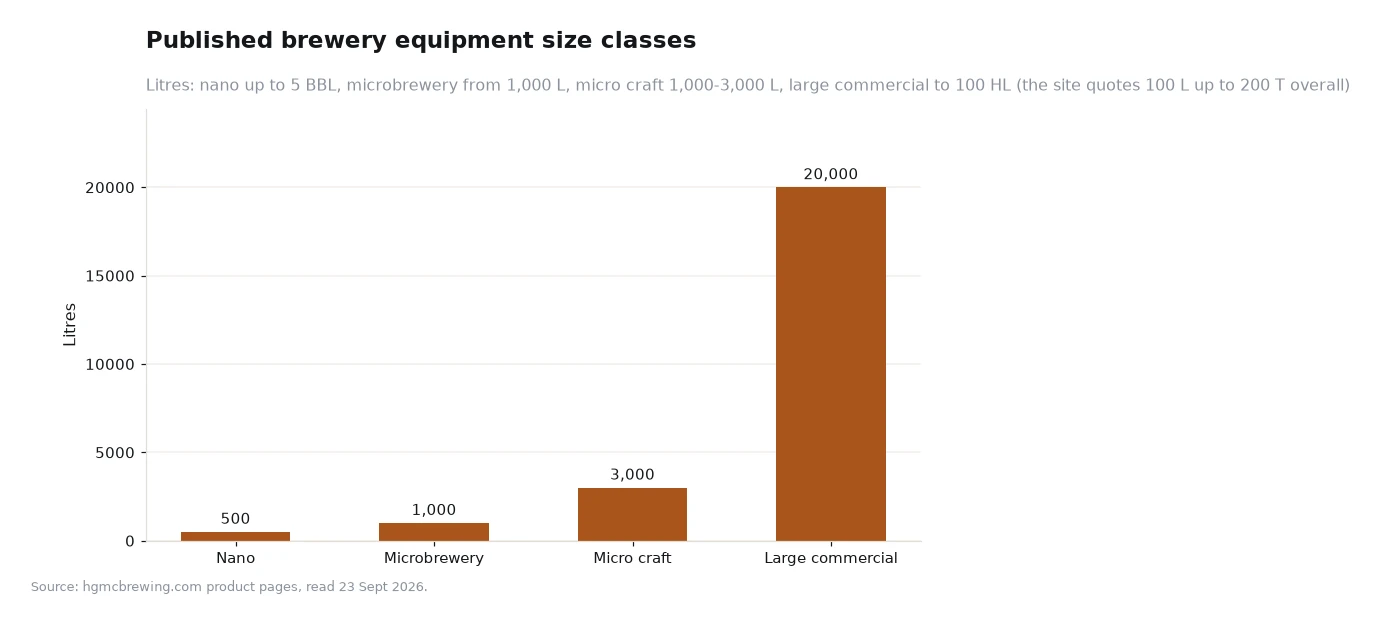
- The published span is 100 L to 200 T, with equipment offered from 1 BBL to 100 BBL and large commercial plant up to 100 HL.
- Named classes in between: a nano brewery at 5 BBL or less, a microbrewery producing 18,000 barrels a year or less, and micro craft systems of 1,000-3,000 L.
- A tonne-class figure is roughly 1,000 L for planning, so 20 T is about 20,000 L and the 200 T ceiling is about 200,000 L.
- Published application cases run from 200 L in Australia to 20 T in Poland, which is the fastest way to see the ladder in real use.
One Ladder Rather Than a Product List
Most suppliers sell in bands. The published hgmc brewing range is a continuous ladder instead: 100 L to 200 T overall, equipment from 1 BBL to 100 BBL, large commercial systems up to 100 HL, and hot products at 20 T-50 T. That matters to a buyer because it means the same design language and the same fabrication standards run from the smallest pilot kit to the largest tank farm, and a brewery that grows does not have to change supplier to change size.
It also means the ladder has to be read as a series of purposes rather than a series of prices. A 100 L kit and a 200 T farm are not competing products; they answer different questions. The useful exercise is to locate your own question on the ladder, then check the published class description for that band before looking at anything else.
What Each Class Is For
The small end is defined by its footprint. A nano brewery at 5 BBL or less takes little space, which is why it turns up in restaurants and taprooms where the kit stands behind glass and the brewer is also the person serving. Above it, the microbrewery class is described as producing 18,000 barrels a year or less, which is a wholesale business with a van, a cold room and a small team — about 2.1 million litres a year if you convert it.
The middle is the busiest part of the ladder for new projects: micro craft systems of 1,000-3,000 L, which is the band where a single brew day fills a few kegs and a canning run without needing a shift system. Beyond that sits large commercial plant up to 100 HL, roughly 10,000 L a turn, and finally the 20 T-50 T systems that the site lists as hot products for industrial brewing.
Reading the Tonne Figures Without Guessing
Tonnes are the least intuitive unit on any brewery page, because a tonne is a mass and a brewery is a volume. The practical bridge is the density of water: a tonne-class figure of 1 T is roughly 1,000 L of wort or water for planning purposes, so 20 T is about 20,000 L, 50 T about 50,000 L, and the published 200 T ceiling about 200,000 L. Use that as an approximation, then confirm the actual brew length in litres.
Converting the other way is equally useful when you are reading a tender or a lease. A room that takes a 1,000 L system needs about one tonne of liquid handling per turn; a lease that specifies a floor loading for 20 tonnes of liquid is describing a 20 T plant, whether the document says so or not. Getting the conversion wrong is how a brewery ends up with a vessel set that does not fit the slab it was bought for.
Published Cases Show the Ladder in Use
The application cases published by country are the best evidence that the ladder is not theoretical. They run from an Australian 200 L installation through 500 L projects in Denmark, Germany, Hungary and the Netherlands, 1,000 L in Canada, Costa Rica, Korea, Spain and the United States, 2,000 L in England, Estonia, Italy and Korea again, 3,500 L in France, and a 20 T system in Poland.
What that list shows is how many breweries sit in the middle bands rather than at the extremes. If you are planning 1,000 L, you are in the most crowded part of the catalogue, which is good news: the configurations, the piping and the control options for that size have been built many times, and the questions you are about to ask have been asked before.
| Published case | Size | Class it sits in (own reading) |
|---|---|---|
| Australia | 200 L | Nano band, a taproom or pilot installation |
| Germany and the Netherlands | 500 L each | Nano to microbrewery, a small wholesale start |
| U.S.A. and Spain | 1,000 L each | Micro craft floor, the busiest part of the ladder |
| England and Italy | 2,000 L each | Micro craft middle, kegs plus a canning run |
| France | 3,500 L | Above the published micro craft band, into small commercial |
| Poland | 20 T | Large commercial, about 20,000 L per turn |
Worked example
The conversions below are a worked example, using 1 BBL = 117 L, 1 HL = 100 L and a planning figure of about 1,000 L per tonne. They are arithmetic, not quotations, and they assume the published sizes are brew lengths rather than total site capacity.
Take the two ends of the published case list. The Australian 200 L kit is 200 / 117 = 1.7 barrels per turn. The Polish 20 T system is roughly 20,000 L, which is 20,000 / 117 = 171 barrels per turn, or 200 hectolitres. The ratio between the two published installations is 20,000 / 200 = 100, so the same supplier built one machine a hundred times the size of the other.
Now the full ladder. The published span is 100 L at the bottom and 200 T at the top, and 200 T is about 200,000 L, so the ceiling is 200,000 / 100 = 2,000 times the floor. Put another way, the interval between a 1,000 L system and a 3,000 L system, the micro craft band, covers only 3,000 / 200,000 = 1.5% of the range, which is why a 1,000 L buyer and a 2,000 L buyer are neighbours on this ladder while a 1,000 L buyer and a 100 HL buyer are not.
One more conversion worth doing before a site visit: 100 HL is 10,000 L, and at 117 L a barrel that is 85.5 barrels a turn. A brewery doing three turns a week at that size moves 3 x 10,000 = 30,000 L a week, or about 1.5 million litres a year across fifty working weeks. Check that figure against your own sales plan before you decide which end of the ladder you are actually shopping on.
Frequently asked questions
What is the practical difference between 100 litres and 200 tonnes?
It is the difference between a pilot kit and a tank farm: the published ceiling is roughly 2,000 times the published floor. Most buyers sit between the nano class at 5 BBL or less, the micro craft band at 1,000-3,000 L and large commercial plant up to 100 HL, so the extremes are rarely the real choice.
How do I convert a tonne figure into litres?
For planning, treat a tonne-class figure as roughly 1,000 L of wort or water, so a 20 T system is about 20,000 L and 200 T is about 200,000 L. It is an approximation for floor loading, utilities and tank counts rather than a specification, so confirm the brew length in litres before you size anything.
Find Your Band Before You Ask for a Quote
Work out your target brew length in litres, convert it to barrels and to tonnes, and mark it on the published ladder. A buyer who arrives with a band rather than a wish list gets a faster, more comparable answer, because the configuration, the piping and the control options follow directly from the class.
The micro craft pages cover the busiest part of the ladder, the large commercial pages cover the 20 T-50 T end, and the brewery-system pages set out the published delivery window of 90-150 days from deposit to door delivery, which applies across the range.
Then plan the building around the class rather than the class around the building. HGMC has shipped to more than 120 countries and provides free 2D, 2.5D and 3D design for space layout, so the size you choose can be tested against your floor plan before a deposit is wired and before the 90-150 day delivery clock starts.
Published figures in this article come from the manufacturer's own website (hgmcbrewing.com), read 23 Sept 2026: the capacity range from 100 L to 200 T, the named size classes, the country application cases, the hot product ranges and the 90-150 day window from deposit to door delivery. All unit conversions and class readings are the author's own arithmetic.[1]