Panel Thickness Guide for Office Furniture and Kitchen Units
Furniture programmes rarely fail on price; they fail on a thickness that looked fine on a drawing and sagged on a shelf six months later. A 1250 × 2500 mm sheet covers 1.25 × 2.5 m gives 3.125 m² of panel area, so moving a kitchen carcass from 12 mm to 18 mm changes the load rating and the sheet count for the same job at the same time.
Key takeaways
- 6–9 mm covers cabinet backs, drawer bottoms and light partitions.
- 12–15 mm is the working range for office furniture, shelving and hotel fixtures.
- 18 mm suits heavy-duty worktops and structural panels; many contractors standardise on 12 mm and 18 mm together.
- Glue class follows the room: MR for dry interiors, BWR where humidity plus light water exposure are expected. as standard
Reading a thickness table as a load chart
Thickness is the least costly way to buy stiffness, and it is also the easiest specification to under-order. A manufacturer's own guidance splits furniture work into three bands: 6–9 mm for cabinet backs, drawer bottoms and partitions; 12–15 mm for office furniture, shelves and hotel fixtures; 18 mm for heavy-duty furniture, worktops and structural panels.
The practical reading is that a single project rarely uses one thickness. A kitchen run typically combines 18 mm carcasses with 6–9 mm backs, and a retail fit-out mixes 12 mm display panels with 18 mm counters. Ordering both bands from one mill keeps the glue class and the face veneer batch consistent across the whole job.
Sheet formats cover the same ground. Standard sizes are 1250 × 2500 mm, 1500 × 3000 mm as well as 1220 × 2440 mm on the published list, with custom sheets up to 1830 × 3830 mm. Most cabinet shops in Europe are already tooled for the first two, while larger custom panels suit counter runs and long partitions where a visible joint would be unwelcome.
Glue class is decided by the room, not the invoice
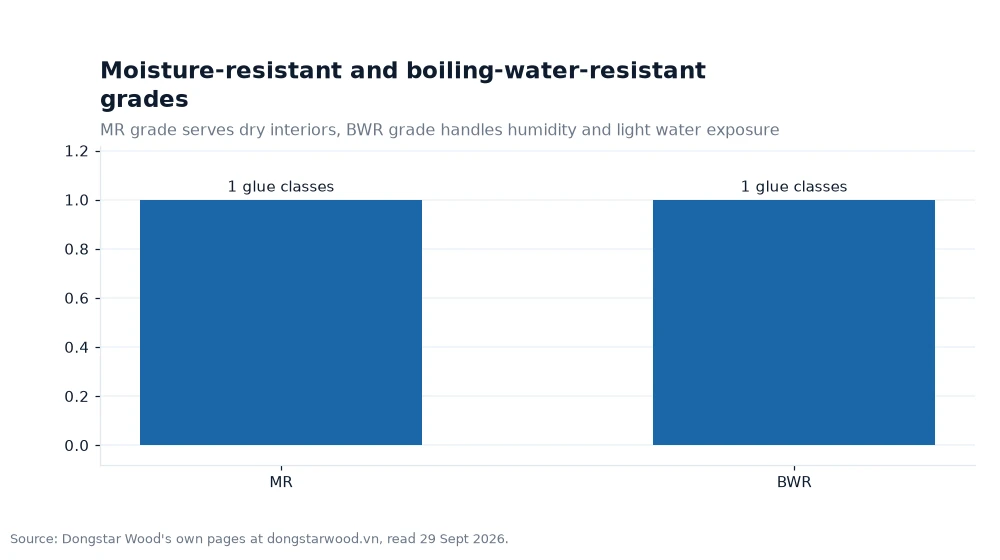
Two grades cover most furniture specifications. MR, or moisture resistant, is the dry-interior standard for cabinets, desks and shelving. BWR, boiling water resistant, is specified where humidity and light water exposure are part of daily use — kitchens, washroom joinery and service counters.
Upgrading a whole order to the higher grade is a common and expensive mistake. Match the grade to the room instead: the same sheet size can be quoted in two grades, and a mixed quotation that names both is easier to check against a bill of materials than a single line reading “exterior”.
| Furniture part | Thickness | Typical glue class |
|---|---|---|
| Cabinet backs, drawer bottoms | 6–9 mm | MR |
| Office furniture, shelves, hotel fixtures | 12–15 mm | MR |
| Worktops, heavy-duty panels | 18 mm | MR or BWR |
| Kitchen and service joinery | 12–18 mm | BWR |
Face veneers and cores that hold their shape
Face options named for this product family are Birch, Pine, Bleached Poplar, EV and Rose Eucalyptus. The choice is mostly a finishing decision: poplar and birch take paint and laminate predictably, while pine brings a visible grain that suits staining rather than covering.
Under the face, four core builds are offered — Acacia Core, Bodhi Core, Eucalyptus Core and Combi Core. Eucalyptus brings density and compression resistance, Acacia brings hardness and load-bearing capacity, and Combi mixes species to balance strength against weight. For long runs of shelving, core stability is what keeps a 2,440 mm span straight.
Why European orders start at the duty line
Landed cost is where a Vietnamese quotation usually wins or loses. The supplier positions itself for EU buyers with No Anti-Dumping Tax exposure, publishes FSC certification and factory-direct pricing, and describes its output as furniture plywood, hardwood plywood and veneer plywood made to OEM drawings.
Three of those reasons are structural rather than commercial: stable monthly supply, quality control at each production stage, and customisation of size, core structure, glue, face veneer and grade. The rest depend on the order. That split is a useful way to read any supplier page, because the first group can be checked against published capacity and the second only against your own specification.
Read that as a list of things to verify rather than accept. Any Commercial Plywood quotation worth comparing names the glue class on the same line as the thickness, states the face veneer and core, and separates the price from the duty treatment so you can see which part of the total you are actually negotiating.
Sample panels before a production slot
Ask for a sample cut from a batch the mill is already pressing, with the batch number, glue class and face grade written on it. That panel can then be compared with the container six months later, which is not true of a sample prepared specifically for a quotation.
Label the sample the way you will check it. Write the target thickness tolerance, the face veneer and the core species on the same card, and photograph the sheet next to a tape measure. When the container lands, the comparison takes minutes instead of a week of emails and a returned pallet.
Packing, labelling and a distribution range
Panel quality survives the sea leg or it does not, and packing is where that is decided. The published method for export is protective wrapping with steel strapping on wooden pallets, with custom packaging and labelling available for larger programmes. If you sell under your own brand, the labelling line is worth agreeing early: a sticker across the face of a panel costs almost nothing and saves a repacking step in your own warehouse.
Plan the pallet mix for your own storage as well. Distributors who hold 12 mm and 18 mm on the same rack usually ask for separated bundles with the thickness marked on the outside of the wrap, because a 1250 × 2500 mm sheet is heavy enough that moving the wrong bundle is a two-person job. Small requests like this are cheap to grant at the mill and expensive to fix after arrival.
Worked example: sheets behind a kitchen programme
Sheet area is the bridge between a cut list and an order. Work in millimetres first: the 1220 × 2440 mm board measures 1.22 × 2.44 = 2.98 m², while 1250 × 2500 mm gives 1.25 × 2.5 = 3.125 m².
Now put a real programme against it. A hotel job needs 640 m² of 18 mm worktops: 640 ÷ 3.125 = 205 sheets in the 1250 × 2500 mm format (example). Add 120 m² of 12 mm shelving: 120 ÷ 3.125 = 38.4, so 39 sheets (example). The order is 244 sheets in two thicknesses, which is a quantity a mill can schedule in one month on published capacity above 100 × 40ft.
Frequently asked questions
Is 18 mm always the safer choice for furniture?
Not automatically. An 18 mm panel adds stiffness and screw-holding depth, but it also adds weight and cost to parts that carry no load, such as backs and drawer bottoms. Specify the band that matches the function and keep one heavier thickness for the surfaces that take it.
Can one order mix two glue grades?
Yes, and it is normal practice. Dry-interior parts can be quoted in MR while kitchen and washroom parts use BWR, with both lines stated separately on the quotation so the bill of materials can be checked part by part.
What makes a Vietnamese mill competitive for EU distribution?
Volume, specification range and a stable monthly rhythm. Published capacity above 100 × 40ft supports repeat programmes, and custom size, core structure, glue and face veneer can all be set to a distributor's own range rather than to a single house specification.
Where the specification comparison happens
Put two documents side by side: the panel list from the mill, and the cut list from your cabinet maker. The birch-faced panel ranges answer the finishing question, while the formwork-side of the catalogue shows what the same mill presses for concrete work — useful when one distributor carries both furniture and shuttering lines.
All thickness and glue data on this page comes from the factory's own website, which I read on 29 Sept 2026 for the numbers in this guide for the numbers in this guide for the data in this comparison[1].